

I’ve had a surprising number of business owners ask me the same question lately. “Do I still need a website, or can I just run off a Google Business Profile and socials?”
I get why people ask. Google Business Profiles are powerful. Social platforms can drive real attention. And websites have a reputation for being expensive, painful, and full of jargon. Website PTSD is real.
But here’s my view, in plain English. Your Google Business Profile and socials are the shop window. Your website is the store. If you want control, longevity, and a place where your content can actually live, you still need a website.
This isn’t a tech project. It’s a marketing project. If you treat it like a tech project, that’s where the stress, cost blowouts, and unfinished “staging links” come from.
Can you get away with no website anymore?
If you want the honest answer, you can get away with it in some cases. But it’s a gamble, and most business owners don’t realise what they’re betting.
Your Google Business Profile is the cornerstone of local search. If you’re a local services business, it’s a must. Socials can also be a legitimate growth channel, especially for businesses targeting younger audiences who live on Facebook, Instagram, and TikTok.
The problem is ownership.
You don’t own your Google Business Profile. You don’t own your social media presence. They can be taken away, suspended, hacked, or buried by an algorithm change at any time. If your whole business “exists” on someone else’s platform, you’re renting your reputation.
Your website is the opposite. It’s the place where you control the narrative, the messaging, and the content. It’s where your proof lives. It’s also the place your marketing campaigns usually rely on to convert.
I saw a business recently that had been operating for more than two decades with no website. Just a Google Business Profile. Two bad reviews later, they suddenly looked dodgy online and they wanted a website yesterday. That’s not a rare story. It’s a predictable one.
What a website is actually made of
Most people think a website is the code. It’s not.
A website is the quality of the imagery you use, the clarity of the message, and how quickly someone can work out:
- Do you exist?
- Are you credible?
- Have you done this before?
- What should I do next?
The technical build matters, but it’s rarely what makes a website convert. The biggest difference between a site that works and a site that looks like every other knob competitor down the road is messaging and content.
If you’ve ever opened a staging link and thought, “Why does this look like a template I could’ve downloaded myself?”, that’s usually because the project started with the build and left the hard part to the business owner at the end. “Just add your photos and copy later.” Later never comes.
How much should a website cost?
This is where business owners feel like they’re at the mechanic. You get a quote and you’ve got no idea if you’re being looked after or being played.
So here’s a realistic guide. These are not hard rules, but they’re strong benchmarks.
Micro businesses and startups
If you have more time than money, tools like Wix, Squarespace, and Shopify are totally fine. If you’re starting out, don’t be precious. Get a presence live and move on.
For a very simple one-page or template site, around the $2,000 mark can be feasible. This suits businesses that just need to look credible and be findable, not necessarily rank for competitive search terms.
Typical services and B2B websites
A templated but well-built services website commonly sits in the $5,000 to $8,000 range, depending on page count and complexity. If you’re building out 20 to 30 pages with proper structure and decent copy, you’re usually closer to the upper end.
A key note here. Many quotes do not include copy. If the copy isn’t included, the project often stalls. Which is why I rarely recommend building without copy support.
Custom design and more complex builds
Once you move into truly custom design, you’re paying for manual work. A designer creates something unique, then a developer has to code it to make it real. That’s where you commonly see $10,000+ for an informational site.
When you see $20,000 to $50,000+, there usually needs to be a real reason. Integrations, complex ecommerce, stock syncing, product systems, very large sites, serious UX requirements. That’s not most SMEs.
If you’re a basic B2B business getting quotes north of $10,000 with no clear complexity, my advice is simple. Keep shopping.
Why business owners get website PTSD
Website projects go off the rails for one main reason. They’re run as a development job, not a marketing job.
You meet a web provider, they show you a few sites you “like”, then they send you a wireframe or staging environment and say, “Don’t worry about the photos and messaging, you can put that in later.” Then the questions start.
Can you write the copy? Can you source images? Can you provide your service descriptions? Can you rewrite your homepage headline? Can you approve these pages?
Most business owners are busy. They don’t have time to become a part-time copywriter and creative director. So the project pauses, the developer waits, and eventually the whole thing becomes a graveyard of half-finished pages.
A good website process starts with the end in mind. What do you want the website to say when someone lands on it? What should it achieve? What should someone feel in the first ten seconds?
That’s marketing. Not tech.
Messaging framework first, unless you’re the rare exception
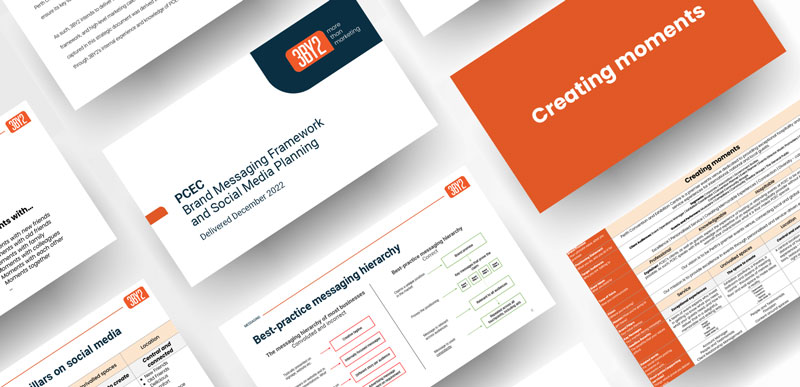
If you want to avoid wasting money, do this first. Build a messaging framework.
It’s usually a single page, but it forces the important thinking:
- What do you actually do?
- Who do you do it for?
- What makes you different?
- What’s your brand promise?
- Where do you sit versus competitors?
Most businesses do not have this clear. And if you build a website without it, you’re guessing forever about what goes where and why.
Ninety-five percent of the time, messaging comes before web. If a client is unusually clear and prepared, happy days, we can go straight into build. But that’s not most businesses.
What pages people actually care about
Here’s a fun reality check. No one loves your business more than you do. But no one else cares.
Most visitors use your website as a credibility check. They want to confirm you’re real, competent, and safe to talk to.
Across many industries, the most visited pages are usually:
- Home
- About
- Case studies, projects, or work
- Team pages
People want proof. Who have you worked with? What have you done? Who are your people? That’s where credibility is built, and it’s often the part businesses spend the least effort on.
Hosting, domains, and maintenance: the boring stuff that matters
This is the part everyone wants to skip until something breaks.
Your domain name is your address. The DNS is what points that address to the right place. Your hosting is the server where the files actually sit.
Here’s my practical recommendation. Keep your domain and DNS with a reputable IT provider. Why? Because DNS controls your email records as well. If your website goes down, it’s annoying. If your email goes down, you’re a headless chook.
Hosting varies wildly. If you’re paying $7 a month, you’re usually paying for cheap storage on an overloaded server with hundreds of other websites. If one gets hit, yours can slow down. Latency can be poor. Support can be nonexistent.
Good hosting costs more because you’re paying for better infrastructure, better performance, and usually local hosting, which matters for Australian businesses.
Maintenance is the bigger piece. Websites run on themes and plugins that get updated constantly. Done properly, someone is assessing updates weekly, managing vulnerabilities, testing compatibility, and making sure your site doesn’t quietly rot from the inside.
Backups matter too. A daily backup is not automatically “safe”. If a site is hacked and you don’t notice for five days, daily backups can just back up the hack again and again. Good backup management keeps history and allows a clean restore.
So yes, decent hosting and maintenance can look like $100 a month rather than $7. That’s not because we love charging money. It’s because someone has to do the work, and I’d rather you be able to call a human when something is on fire.
The best questions to ask before you start a website build
If you want to avoid getting stitched up, ask these before you sign anything:
- What’s the purpose of this website?
- What is included, and what is not included?
- What is my involvement, and in which phases?
- Is copywriting included?
- What are the payment milestones, and what deliverables sit under each milestone?
- Who owns the domain name, and who controls DNS?
- Is basic SEO setup included, including Google Search Console submission?
- What happens after launch? Hosting, maintenance, updates, backups, support.
If you ask those questions and you get clear answers, you’re in a much better position.
If you get vague answers, vague timelines, or a request for 90 percent up front for a product you can’t see, don’t walk. Run.
The takeaway
A website is not a tech project. It’s a marketing project.
If you get the messaging, imagery, and structure right, the tech becomes the easy part. If you ignore the messaging and hope the developer will magically make you sound different, you’ll end up with a site that looks fine, says nothing, and never quite gets finished.
Do it once. Do it right. And build something you actually own.